
The shoemaker’s children finally get shoes
The shoemaker’s children go barefoot. The proverb describes me rather well.
I have been building websites since 1998. For more than twenty years I built them for clients at an agency, and for the last few I have been working on the WordPress platform for more than six million sites at Hostinger. In all that time, the websites for my own side projects were an embarrassment. A billiards game that was downloaded millions of times lived on a subdomain of a personal domain, on a site that had not been touched in years. A collection of logic puzzles sat on another subdomain. A fan-made board game map pointed people to a domain that no longer existed. I shipped other people’s sites for a living and left my own on whatever they had been built with the first time.
Last month I rebuilt my personal site by talking to an agent, and then took it headless. Both were about my professional site. This post is about the barefoot children: three personal projects between twenty and thirty years old, the websites they should have had all along, and an archive for every website I have had since the first one.
Old projects, new shoes
All three were WordPress sites already: subsites of a single WordPress multisite, each on a subdomain of chiesi.net, which makes the proverb fit even better. The rules were nearly the same as for my own site: no code written by hand, and wp-admin only once, briefly. Everything the agent needed from the old sites, it read from their public pages and their REST API. The hosting panel was a different story, and I will come back to it.
Each one now has its own domain, a custom block theme, a small plugin for the logic that belongs outside the theme, and the same basics I would insist on for a client: security headers, structured data, an English and an Italian edition linked to each other with hreflang, and Lighthouse scores in the high nineties. There is also no cookie banner, because there are no cookies. Visitor statistics come from an analytics plugin for WordPress, self-hosted and cookieless, and no page loads anything from a third party until you click on it. The old addresses now redirect to the new ones, so twenty years of links still work.
Biliardo — 1996
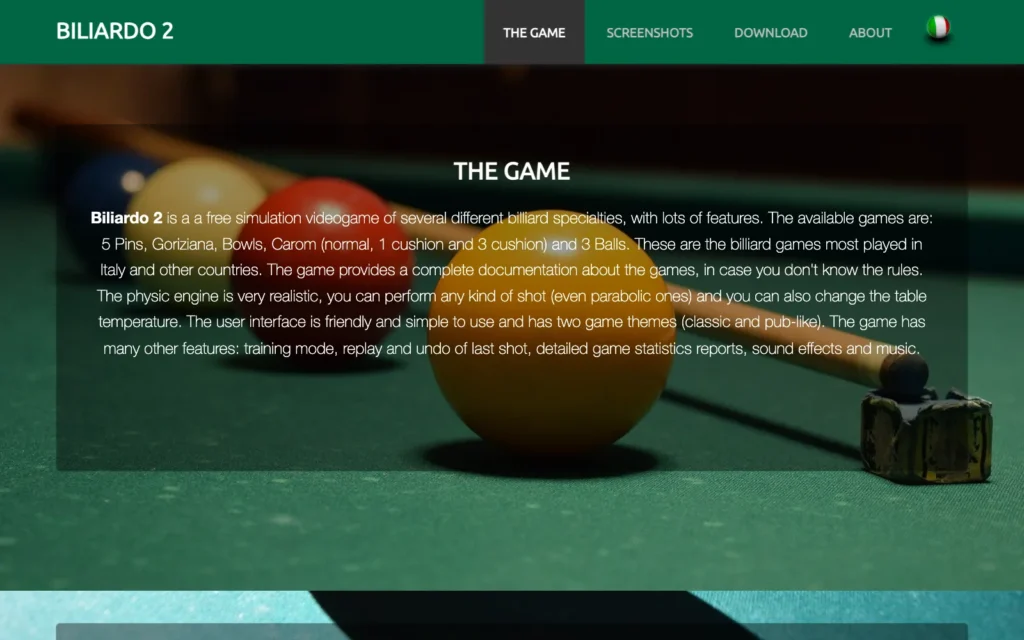
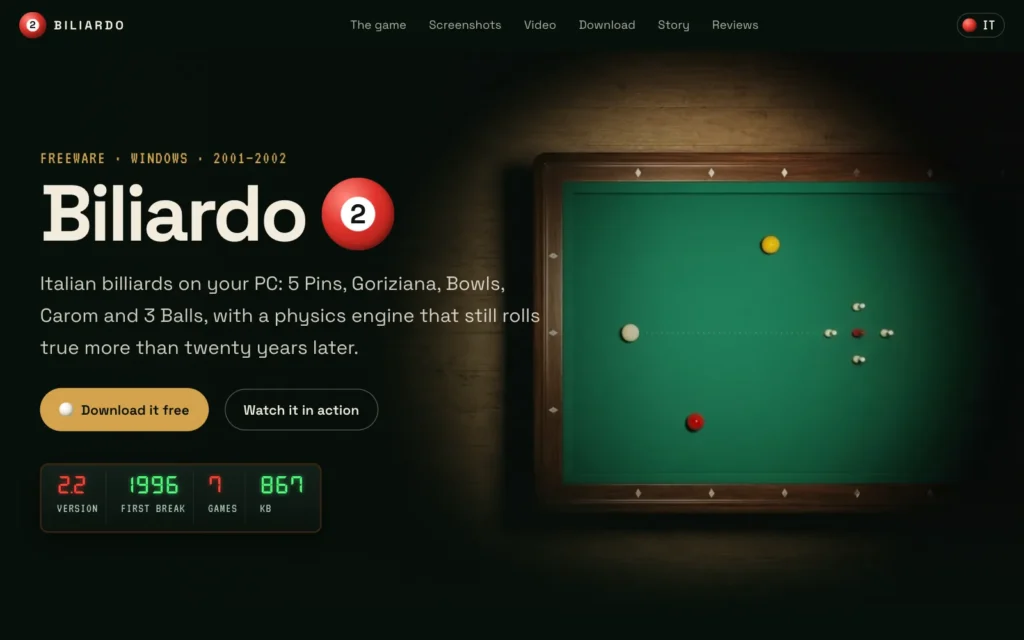
Biliardo is where it all started. I wrote the first version for MS-DOS in 1996 as a C++ programming exercise and gave it away, at a time when very few people in Italy had the internet. Version 2 for Windows came out in 2001, with graphics by Francesco Schiumerini and a new physics engine. It simulated the Italian games (5 Pins, Goriziana, Bowls) that no other billiards game covered. It was downloaded millions of times and reviewed in magazines, which is the part I am still quietly proud of. Version 3 was started in 2002 and never finished.
The new site is a WordPress multisite in two languages. The ten magazine reviews from 2002 to 2007 are reproduced exactly as published on the Italian site. The English site has something the old one never did: faithful English translations of all ten, which I never found the time to write, each linking to its original. The original 640 × 480 screenshots are there untouched, and the download is the original 867 KB installer from 19 March 2002, in a zip. The illustration at the top of the story section shows the kind of desk it was written on: a beige CRT, a ball mouse, floppy disks, a programming book.
Spoiler: recently I built a completely new game, hosted on biliardo.plus, a very ambitious project. A series of articles will follow on this blog to tell the story of how it was built and how it is evolving.
Galactic Riddles — 1998
galacticriddles.com · enigmigalattici.it


The puzzles are nearly as old as Biliardo. I first published them in 1998, on my very first personal website, hosted on GeoCities: classic logic and maths problems from Martin Gardner and others, with the solution hidden until you asked for it.
This rebuild went furthest beyond a migration, because I wanted a new identity for the project, not a new coat of paint. The puzzles now live in a light-hearted science-fiction universe: a small crew on a spaceship that always lands on the wrong planet, where each planet stands for one kind of puzzle. Every puzzle opens with a short scene; the numbers, constraints and answers are unchanged.
The bigger change is that, for the first time, the puzzles exist in English. In Italian they are Enigmi Galattici; in English, Galactic Riddles, each edition on its own domain. Translating dozens of puzzles, solutions and stories by hand was always too much work to even consider, so in more than twenty years it never happened. This time agents translated them in parallel and other agents reviewed the translations, checking that every number, constraint and answer survived the trip. The word puzzles from the old site stayed out of both editions on purpose: Italian wordplay does not survive translation.
Two details I did not expect.
The agent found errors in some of my original solutions. They had been online for years, and nobody, me included, had noticed. The answers stayed the same; the reasoning that leads to them is now correct.
It also toned down the violence, without being asked beyond “keep it light”. Kidnappings, shootings and werewolf hunts became gentler situations with the same logic. Every one of these changes was listed for my review, with a note on why the puzzle still works, so nothing was changed quietly.
Ticket to Ride Italy — 2007
tickettorideitaly.com · tickettorideitaly.it

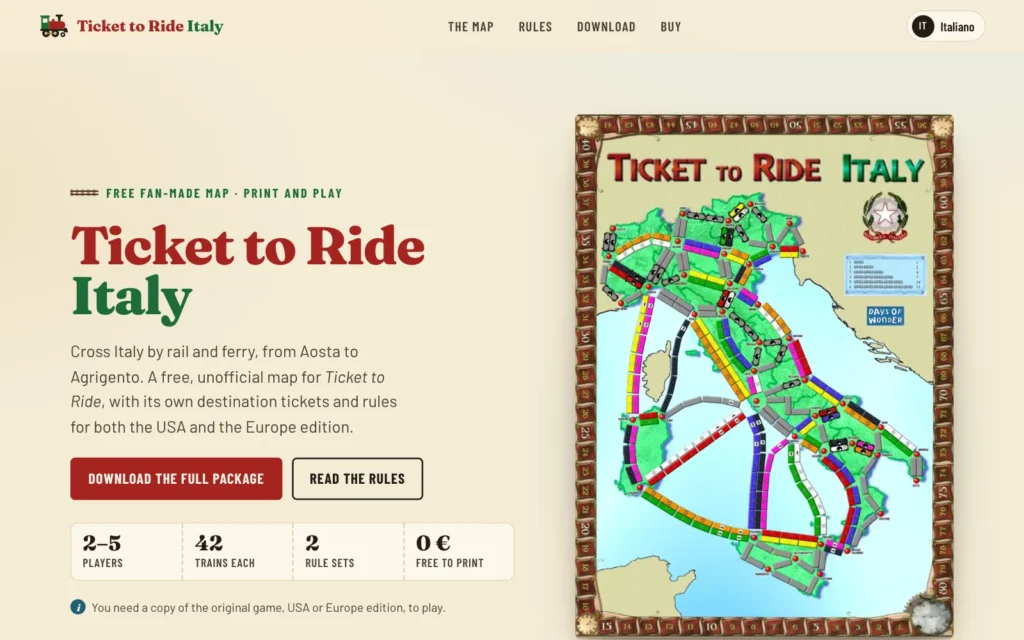
A fan-made Italy map for Alan R. Moon’s Ticket to Ride, with cards and rules, free to print and play.
The downloads are the six original files, byte for byte, checked by SHA-256 after upload, and counted by a small download-counter plugin written for this site and later reused on Biliardo. The map is the original hi-res JPEG, and the CDN’s automatic image optimisation is switched off for it. When you zoom in on a print-and-play map, you should get the real pixels.
The best anecdote of the whole rebuild is here. The rules PDFs still pointed readers to an old domain that no longer exists. Rather than rebuild the PDFs from scratch, the agent rewrote the text inside the original files, using the fonts already embedded in them. The English cover needed the letter “m”, which was not in the embedded subset of its display font. So it added that one glyph to the subset. I would not have known where to start.
The site also has the rules rewritten for clarity (setup, turn, end of game, scoring), and a page of links to the official editions and expansions on Amazon.
Three ways to say “page not found”
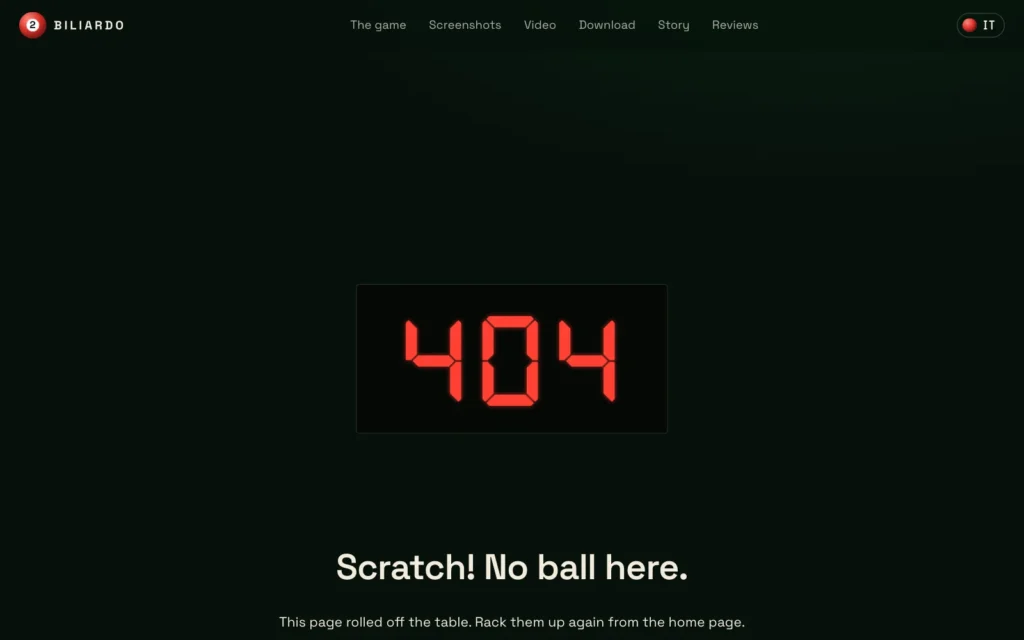
One last touch I never asked for: each of the three sites got its own 404 page, written in its own voice. On Biliardo the 404 lights up on an LED scoreboard; on Galactic Riddles the spaceship has teleported to the wrong coordinates again; on Ticket to Ride Italy the route simply is not on the map. Nobody goes looking for a 404 page, which is exactly why I liked finding these.
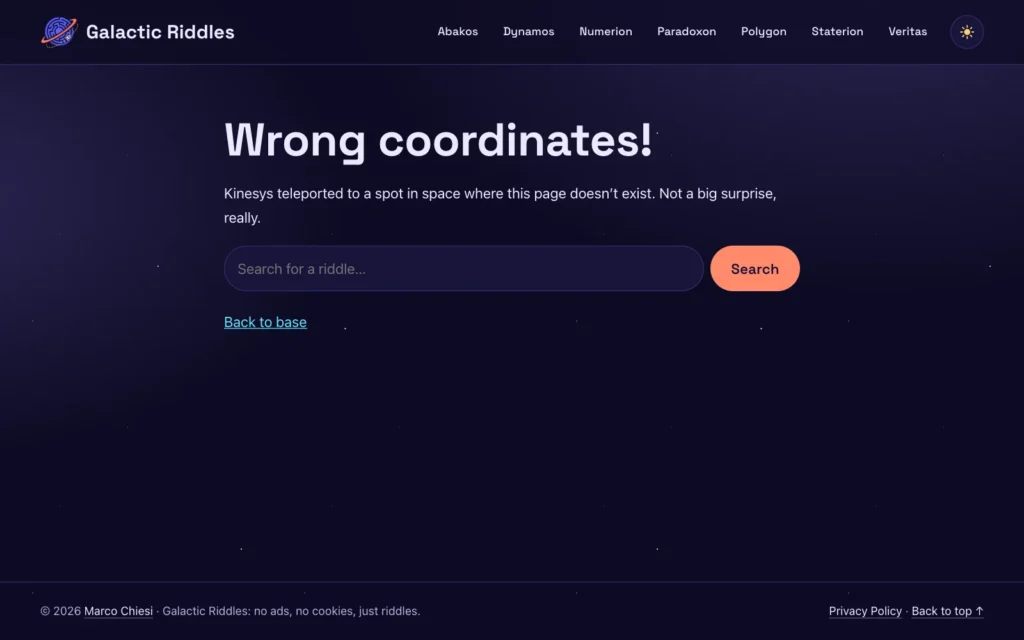
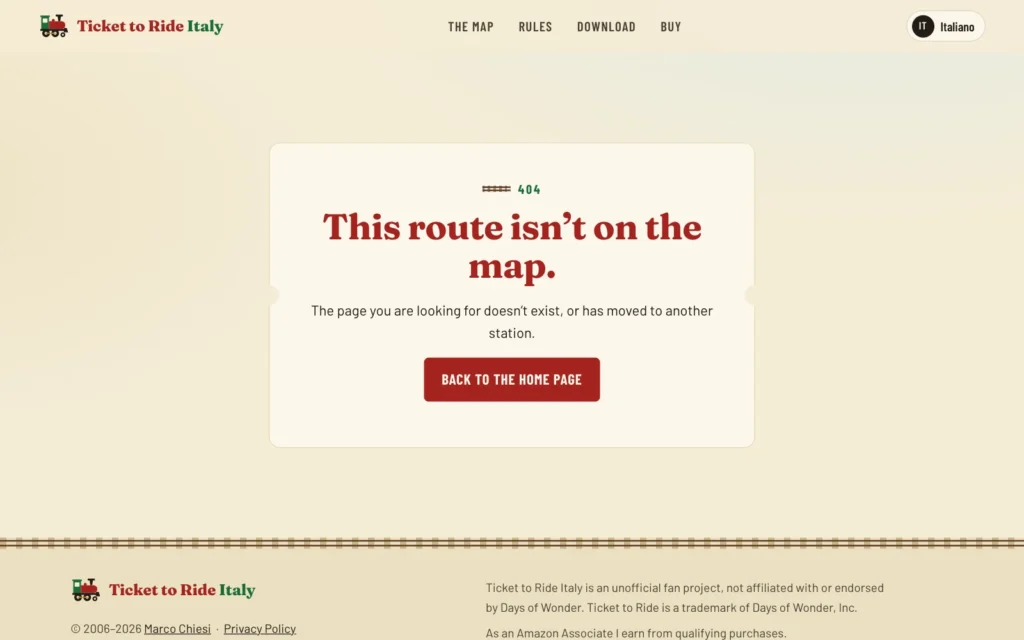
The archive: almost thirty years in one place
Rebuilding the old projects left a question: what about the sites they replaced? And what about all the personal sites I have had since 1998, most of which existed only as half-remembered folders on old hard drives and as captures in the Wayback Machine?
So the last project was archive.chiesi.net: a static archive of twelve old websites, each on its own subdomain, from a 1998 GeoCities home page to the first AI-built version of my personal site, which only ever lived on a temporary domain before going headless. Six are personal sites, six are project sites. A bilingual index page shows them all with a screenshot and the years each one was online, with the four live sites at the top. I liked the proverb so much that it opens that page too.
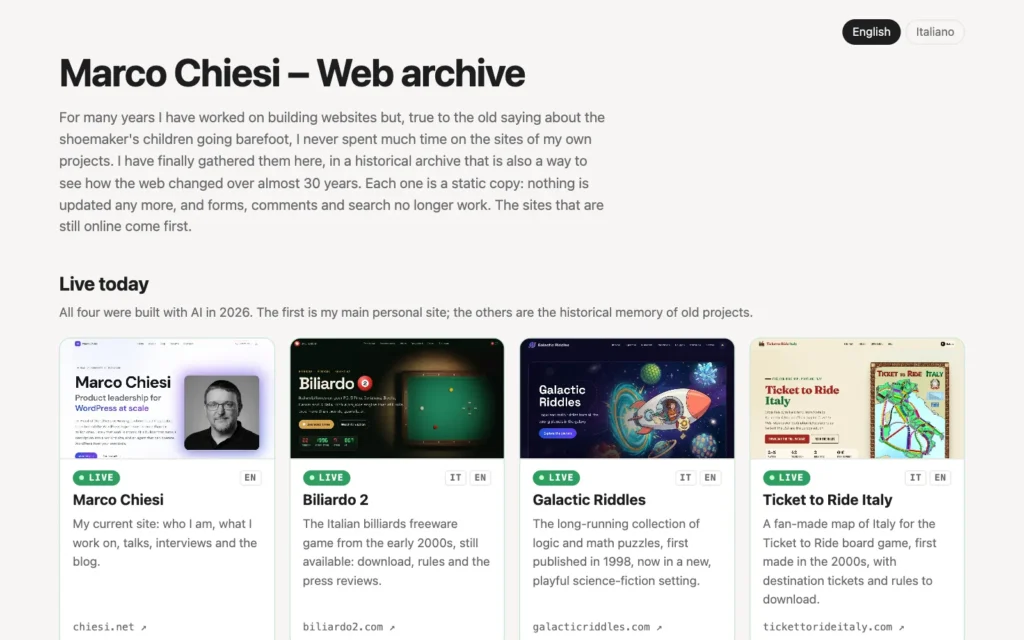
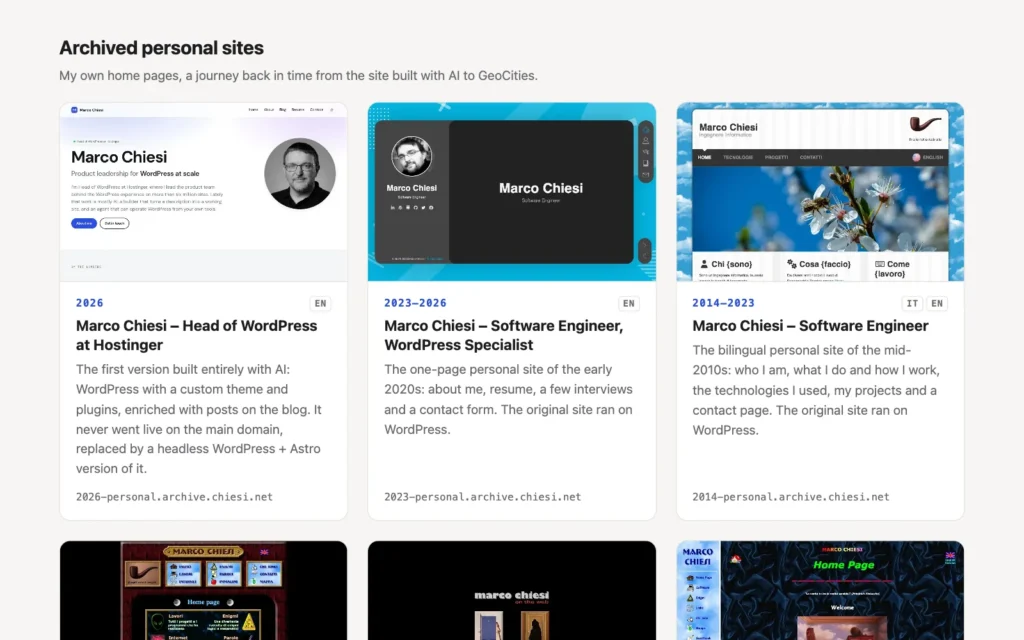
The sources were as varied as the sites:
- The WordPress-era sites were mirrored from their old installs and then cleaned: feeds, emoji scripts and oEmbed removed, links between the old sites rewritten to point at their archived copies, fonts and images made local, and download files given their real names back.
- The oldest sites came from the Wayback Machine, through a script that crawls the archived copies and picks, for every page, the capture closest to a chosen date, so each site is shown as it was at one moment, not as a patchwork of years.
- The hand-made HTML sites from the early 2000s came from a backup folder that had survived on the server after several migrations.
- What none of those had, I found in four zip files from old drives: fifteen pages of the 1998 site that the Wayback Machine never saved, the original home icon, and 22 freeware downloads. Before that, 115 links in the old software page led nowhere.
The most charming result is the February 1999 GeoCities version: a frameset, a guestbook and Radiohead MIDI files as background music. Those now play only when you click, through a small self-hosted player, because the archive follows the same rules as the live sites: no cookies, no third-party requests (verified by a headless browser crawling every page), and one privacy policy for the lot. Other people’s email addresses and IP addresses, which old guestbooks and contacts lists were full of, have been removed. And the whole archive is hidden from search engines: it is a museum, not a competitor to the live sites.
One discovery was less charming. While mirroring the old sites, the agent found two full backups of my previous personal site from 2023, left by a backup plugin, publicly downloadable from a forgotten folder. They are gone now. Nobody asked for an audit of the old sites; it was reading them carefully enough to archive them that found the problem.
How it was built
The tools
Everything in this post was built with Claude Code, Anthropic’s coding agent, running in the terminal, and every one of its turns, including those of the sub-agents it launched, ran on Claude Opus 5.5. It worked in auto mode, where a safety classifier approves each action and stops anything risky without waiting for me. The illustrations on Biliardo and Galactic Riddles (77 images in all, including the seven planets and a scene for every puzzle) were generated with OpenAI’s GPT Image, through an internal tool we use at Hostinger.
For the three game sites, the agent did not work through point-and-click integrations either. It wrote small scripts: one to deploy themes and plugins through the Hostinger API, another to import content through the WordPress REST API, both idempotent so they could be re-run safely. It called the Hostinger and image MCP servers a little over a hundred times, but ran over 2,000 shell commands. Around those scripts it used a long list of ordinary tools: Python and PHP for most of the work, Playwright and headless Chrome to look at and test what it had built, Lighthouse for performance, ImageMagick and cwebp for images, fontTools, qpdf and Ghostscript for the PDF surgery, and git for everything.
The archive, tool by tool
The archive was the most tool-heavy project of the four, and almost none of it went through MCP: Hostinger’s connector failed to sign in that day, so the agent used the hosting API directly and got on with it. Everything else was a script it wrote for the job:
- Mirroring. A mirroring tool copied each old WordPress site, and a cleanup script turned the copies into clean static pages: feeds and tracking removed, links between the old sites pointed at their archived copies, fonts and images made local.
- The Wayback Machine. A script walks the Internet Archive’s index of captures and, for every page, picks the one closest to a chosen date, so each site is shown as it was at one moment. Another recovers each page’s original “last updated” date.
- Checking. A headless browser crawls every page to prove there are no cookies and no third-party requests, two more scripts hunt for broken links, and Playwright captures the images on the index page.
- Building and publishing. A build script generates the bilingual index page from a list of sites, and a deploy script uploads the result file by file through the Hostinger API, with git keeping one branch per change.
- Music. The old MIDI files play through JZZ, a small self-hosted JavaScript MIDI player, and only when you click.
The numbers
The numbers, counted from the session transcripts the same way as last time:
| Biliardo 2 | Galactic Riddles | Ticket to Ride Italy | Archive | |
|---|---|---|---|---|
| Days | 25–26 Sep | 25–27 Sep | 26 Sep | 2–3 Oct |
| My prompts | 21 | 51 | 12 | 49 |
| Words I typed | 667 | 1,145 | 483 | 1,588 |
| Agent tool calls | 356 | 1,210 | 296 | 1,244 |
| Agent active time | 2.7 h | 6.8 h | 2.7 h | 6.3 h |
Active time counts only the gaps of five minutes or less between the agent’s actions, not the hours in between when I was doing something else.
In total: 133 prompts, about 3,900 words typed, no screenshots, and 3,106 tool calls, over about 17 hours of the agent’s active time spread across six days. Two things stand out. The Galactic Riddles count is high partly because the project started from a 1,650-word brief I had prepared beforehand, and partly because a good number of those 51 prompts were about the tools, not the site: reconnecting an MCP server, or chasing a background agent that refused to stop. And the three rebuilds overlapped: Biliardo, Galactic Riddles and Ticket to Ride ran in parallel sessions for two days, which is why their dates overlap in the table.
What I did by hand
I want to be precise about this, as I was last time. I did not write code. I opened wp-admin once, briefly, to set up the statistics plugin. And I opened the hosting panel for a handful of chores:
- Deleting files. The hosting API can upload files but not delete them, so leftovers from the archive build (placeholder pages, the exposed backups, test files) were removed by me, by hand.
- Copying the old backup folder to where the API could read it.
- Taking a full backup before the agent changed a live configuration, and purging a cache once.
- Applying a few redirect rules on the old domain myself.
I also supplied what only I had: the brief for Galactic Riddles, the old drives, the GeoCities address, a screenshot of a lost version of my home page, and a long list of corrections to the archive’s text. The agent did everything else.
Remembering to ask
The post about my own site ended with the lesson that the agent had never offered a security review: “the audit is a prompt you have to remember to write”. This time I remembered. Biliardo and Galactic Riddles each have a written security audit in their repositories, and the findings were familiar. There were no critical or high-severity issues, and escaping, nonces and capabilities were right everywhere. The remaining items were a list of hardening fixes: a missing ABSPATH guard on theme pattern files, a deploy script that would have uploaded the contents of .git/ if the server had not refused them, and an importer that would forward credentials across a redirect. None of them were visible from the front end, which is why you have to ask.
Why now
These projects are old. Biliardo is thirty this year, and the youngest, the map, is twenty. The reviews, puzzles and maps at their heart are the ones I made back then, but much of what now surrounds them is new: translations I never had time for, an English edition of the puzzles, a whole universe to set them in, and an archive for everything that came before. None of that was impossible before. It was just never going to fit into my evenings. What changed is the cost: the gap between “I should really fix that site” and a finished site has shrunk from months of work I was never going to find the time for to a couple of days of describing what I want and saying what is wrong.
For twenty-eight years I was the cobbler. Other people’s sites got the good work, because that was the job, and mine got whatever was left, which was usually nothing. I do not think AI makes anyone a better cobbler. It does mean I no longer have to choose between my customers’ shoes and my own children’s.
For the first time I can link to every one of my personal projects without apologising for the website first, and to the old ones as well.
Disclosure, and who wrote this
I work at Hostinger and lead the WordPress products. All of these sites run on my own Hostinger plans, the same ones available to anyone. They are personal projects, built in my own time.
As with the previous posts, the first draft of this article was written by the agent, from the project repositories, the session transcripts and my notes. I then corrected it, as I did the sites. The words are largely its; the corrections, the opinions and the byline are mine.
Related reading
The Head of WordPress goes headless
Another weekend project: the same site rendered three ways (WordPress, Next.js and Astro) from one headless WordPress backend, and why AI makes headless far more tempting than it used to be.
24 min read

How I rebuilt my WordPress site without opening WordPress
No code, no wp-admin, no control panel: how my site was built, filled and debugged over a weekend by an agent, and why most of its 1,499 tool calls went on things I did not need.
22 min read

WebMCP in the block editor — WordCamp US 2026 Contributor Day
WordCamp US ran Contributor Day as a hackathon. Five of us spent it teaching the block editor to expose its own actions as WebMCP tools, so an agent can edit a post live in the browser.
5 min read